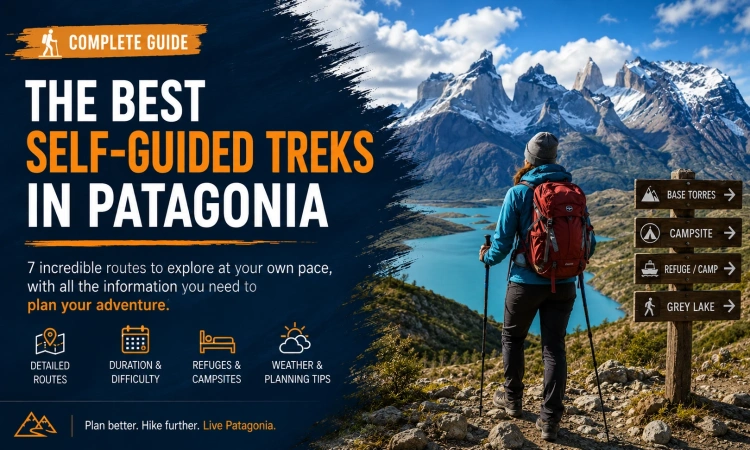
Patagonia rewards independent trekkers, but it does not forgive vague planning. The best Patagonia self guided treks combine world-class scenery with route structures that actually work for travelers managing park entries, refugios, campsites, ferries, and weather windows on their own. If you want the freedom of hiking at your own pace without improvising every detail in the field, choosing the right trek matters as much as training for it.
Some routes are famous for good reason. Others are better for travelers with fewer days, less backpacking experience, or a stronger preference for hut-based comfort over full camping. The smartest way to choose is not by chasing the longest trail. It is by matching the trek to your time, fitness, and appetite for logistics.
What makes the best Patagonia self guided treks
A great self-guided trek in Patagonia needs more than scenery. It also needs clear route flow, reliable overnight points, and transport that can be coordinated without guesswork. That is why the strongest options are concentrated in Torres del Paine and the El Chalten area. These regions offer iconic landscapes, established trail networks, and enough trekking infrastructure to support independent travel without requiring technical mountaineering skills.
Weather is still the wild card. Patagonia can give you blue skies at sunrise and punishing wind by lunch. So when evaluating routes, it helps to think beyond distance. Ask whether the trek has flexible daily stages, whether accommodations book out months ahead, and whether poor weather on one day ruins the entire plan. The best self-guided routes leave room for real-world conditions.
1. The W Trek, Torres del Paine
If most travelers ask about the best Patagonia self guided treks, this is the route they mean. The W Trek is the classic choice because it delivers Torres del Paine’s headline views in a manageable format. Over four to five days, you can hike the three major valleys tied to the park’s biggest landmarks - Base Torres, the French Valley, and Glacier Grey.
This is the best fit for travelers who want a bucket-list Patagonia experience without committing to a full expedition-style circuit. Trail infrastructure is strong, and you can complete it with refugio stays, camping, or a mix of both. That said, the route is not casual. Daily distances can be substantial, weather can slow progress, and accommodation sequencing needs to be booked correctly from the start.
West-to-east and east-to-west both work, but the feel is different. Starting from the west often spreads effort more evenly. Starting from the east puts the Torres viewpoint early, which some hikers prefer if weather looks uncertain later in the trip.
2. The O Circuit, Torres del Paine
For stronger hikers with more time, the O Circuit is Patagonia’s premier self-guided long trek. It loops around the entire Paine Massif, usually in seven to nine days, and includes everything on the W plus the quieter northern side of the park. That means less crowding, bigger wilderness feel, and a stronger sense of journey.
The trade-off is commitment. You need more days, more physical endurance, and more confidence carrying gear or managing a longer route sequence. The John Gardner Pass is the key challenge. In good conditions it is unforgettable, with dramatic views over the Southern Patagonian Ice Field and Glacier Grey. In bad weather it can be slow, cold, and demanding.
For many experienced trekkers, this is the most complete route in Chilean Patagonia. For others, it is more trek than they actually need. If you only have a week in the region and want some recovery time before or after the hike, the W Trek may be the better call.
3. Huemul Circuit, El Chalten
The Huemul Circuit is one of Patagonia’s most serious self-guided treks. It is stunning, remote, and far less structured than Torres del Paine. Over roughly four days, hikers cross wild terrain near the Southern Patagonian Ice Field, with views that feel much bigger and less trafficked than day-hike corridors around El Chalten.
This is not a first Patagonia trek. River crossings, exposed sections, navigation awareness, and rapidly changing conditions make it suitable for experienced backpackers only. You also need to be comfortable with a more self-reliant style of trekking. If the W Trek is the polished classic, the Huemul Circuit is the high-consequence alternative for hikers who actively want that edge.
For the right traveler, it is exceptional. For the average independent visitor, it is better admired than underestimated.
4. Laguna de los Tres and Cerro Torre combo, El Chalten
Not every great self-guided Patagonia trek needs hut reservations or a week-long itinerary. In El Chalten, some of the best trekking comes from linking classic long day hikes into a short self-guided hiking trip. The standout pairing is Laguna de los Tres with Laguna Torre or the Cerro Torre viewpoint.
This option is ideal for travelers who want flexibility, prefer to sleep in town, or are building a broader Patagonia itinerary with mixed activities. Laguna de los Tres brings the iconic Fitz Roy view, while the Cerro Torre side offers a different mood - glacial, wind-shaped, and more atmospheric. You can do them on separate days and still feel like you have had a serious trekking experience.
The compromise is obvious. You do not get the immersive, multi-day trail flow of Torres del Paine or the Huemul Circuit. But for many visitors, especially those balancing comfort and scenery, this is one of the highest-reward self-guided formats in the region.
5. The Dientes Circuit, Navarino Island
For trekkers who want something raw and unusual, the Dientes Circuit is one of the most remote marked routes in Patagonia. Located on Navarino Island near Ushuaia, it is often described as the southernmost multi-day trek in the world. The terrain is rugged, muddy, and exposed, with little of the built infrastructure that defines Torres del Paine.
This is Patagonia for hikers who value solitude over convenience. Wayfinding can be more challenging, camps are wild, and the conditions are often harsher than travelers expect. It is a rewarding self-guided route, but only if you are prepared for a less forgiving environment.
In practical terms, this trek appeals to repeat Patagonia travelers more than first-time visitors. If your goal is to see the region’s icons efficiently, it is not the obvious pick. If your goal is to feel genuinely off the map, it stands out.
6. The W Trek Short Version
A shorter W Trek itinerary deserves its own place because time is one of the biggest constraints for international travelers. If you have three to four hiking days, it is still possible to experience the strongest sections of Torres del Paine without completing every branch of the full W.
Most short versions prioritize Base Torres and either the French Valley or Glacier Grey. Which one is better depends on your preferences. French Valley gives you one of the park’s most dramatic mountain amphitheaters. Glacier Grey brings longer glacier views and a stronger sense of Patagonia’s ice landscapes.
This format works especially well for travelers who are combining Torres del Paine with El Calafate or El Chalten, or who want a self-guided trek that feels ambitious but remains realistic within a tighter schedule.
7. Base Torres as a self-guided overnight hiking trip
Strictly speaking, Base Torres is often treated as a day hike. But when built into an overnight stay near the trailhead or as part of a one- to two-night route, it becomes one of the most accessible self-guided trekking experiences in Patagonia. For travelers who want the famous towers without a longer multi-day commitment, this is the clearest entry point.
The climb is steep and the final section is demanding, but logistics are simpler than on longer routes. It suits independent travelers testing their comfort with Patagonia before booking something bigger. It also works well for mixed-ability pairs, where one traveler may not want a full circuit.
How to choose the right trek for your trip
The best route is the one you can actually enjoy, not just finish. If this is your first Patagonia trek and you want the strongest balance of scenery, infrastructure, and satisfaction, start with the W Trek. If you are experienced, have extra days, and want a fuller expedition feel, the O Circuit is the clear upgrade.
If you prefer flexible logistics and town-based comfort, El Chalten delivers excellent self-guided hiking without the reservation puzzle of Torres del Paine. If you are a seasoned backpacker chasing remoteness, the Huemul Circuit or Dientes Circuit may be worth the extra complexity.
Timing matters too. Peak season gives you the best access to services but the most competition for beds and campsites. Shoulder season can feel quieter and more atmospheric, but weather risk rises and some services may be limited. In Patagonia, every route decision touches logistics.
Planning tips for Patagonia self-guided treks
The biggest mistake travelers make is treating self-guided as unstructured. In Patagonia, self-guided still needs tight coordination. You need to align entry points, overnight stays, transport timing, and daily hiking distances before arrival. That is especially true in Torres del Paine, where refuge and campsite availability shapes the route as much as your own preferences.
Pack lighter than you think, but do not cut weather protection. Wind, rain, and temperature swings can turn a comfortable day into a hard one fast. Build margin into your schedule when possible. A rushed Patagonia itinerary tends to feel smaller, not bigger.
If you want independence without the booking headache, using a specialist platform such as Booking Patagonia Travel can make the difference between a workable itinerary and a scattered one. That is not about removing adventure. It is about making sure the trail experience is supported by lodging and transport that line up correctly.
Patagonia is at its best when the logistics disappear into the background and the landscape takes over. Choose the route that fits your legs, your time, and your tolerance for complexity, and the trip will feel less like a puzzle and more like what you came for in the first place.
"Discover the best self-guided treks in Patagonia, from the iconic W Trek and the challenging O Circuit in Torres del Paine to the remote trails of El Chaltén and Navarino Island. Compare difficulty, duration, logistics, and required experience to choose the route that best matches your adventure and plan every detail with confidence for an unforgettable independent trekking experience."
Discover the best Patagonia self guided treks, from the W Trek to Fitz Roy routes, with practical advice on difficulty, logistics, and timing.